
How Much Does House Washing Cost in St. Louis?
TL;DR: House washing cost in St. Louis isn't a flat number. It depends on your home's size, how many stories it has, what your siding is made of, how bad the buildup is, and whether you want a one-time clean or a recurring plan. Industry surveys put average house washing costs somewhere between $250 and $800 for most St. Louis homes, with per-square-foot pricing running roughly $0.09 to $0.45 depending on the job. Those numbers are a starting point, not a quote. The only way to know what your house actually costs is a free written estimate. Maverick Softwash walks every property before naming a price, so let's break down why.
You've probably searched "house washing cost St. Louis" and landed on a table full of numbers that don't match your house. That's because every cost guide online is guessing at averages. Your driveway isn't average. Your siding isn't average. Your roofline isn't average.
We're going to walk through the real factors that move your price up or down, what third-party data actually shows for this market, and why the fastest way to a real number is still a free quote.
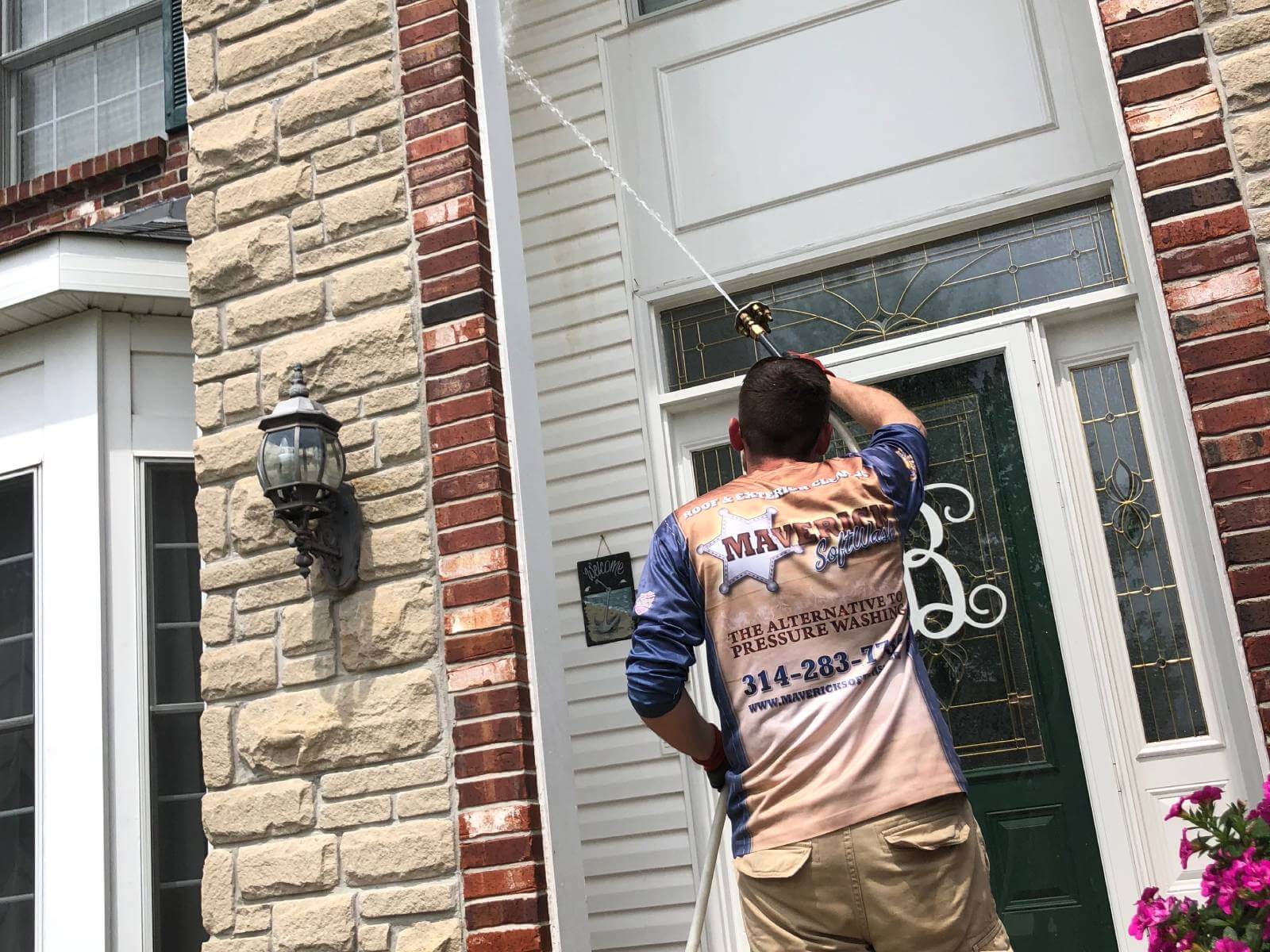
Soft Washing vs. Pressure Washing: Why the Method Changes the Math
Here's something most cost guides skip entirely: the method you use changes the price, and it changes what you're paying for.
Pressure washing blasts a surface with high-PSI water. It's fast, it's loud, and it strips whatever's sitting on top of your siding or roof. The problem is it doesn't touch what's growing underneath. Algae, mold, and mildew have roots. Blast the surface clean and the roots are still there, regrowing within months.
Soft washing uses low pressure and a cleaning solution that kills organic growth at the root. It costs more per visit in some cases because it's doing more than a quick rinse. It's actually solving the problem instead of postponing it.
That difference matters when you're comparing two quotes that are far apart for what looks like the same job. You're not just comparing prices. You're comparing how long the result lasts. A pressure wash might look clean for a season. A proper soft wash job holds up for years. Check out how we handle house washing in Kirkwood to see the difference in person.
There's also a damage question that doesn't show up on any price sheet. High-pressure water can drive moisture behind siding, strip paint, and crack aging mortar joints. That's not a hypothetical. It's a common reason homeowners end up paying for a cleaning and a repair in the same season. Soft washing skips that risk entirely, which is part of why it's worth the extra cost for most St. Louis homes.
The Five Factors That Actually Drive Your Price
Forget flat rates. Every legitimate quote in this market is built from these five variables.
Home Size (Square Footage)
This is the obvious one. More exterior surface means more time, more product, and more labor. A 1,200-square-foot ranch and a 3,500-square-foot two-story are two entirely different jobs, even on the same street. Square footage also isn't the whole story on its own. A sprawling one-story ranch and a compact two-story home can have similar total exterior surface but very different labor requirements once you factor in access.
Number of Stories and Roof Access
A single-story home is straightforward. Add a second story, a steep roof pitch, or tricky access around a walkout basement, and the job gets harder. Harder access means more time on the ladder, more equipment, and more caution around your gutters, windows, and landscaping. Homes with detached garages, extended additions, or fenced side yards can also add time even when the square footage looks modest on paper.
Siding Material
St. Louis housing stock is a mixed bag. Brick bungalows in South City, vinyl-sided ranches in St. Louis County, wood-sided older homes near Kirkwood and Webster Groves — each material behaves differently under a cleaning solution. Brick is porous and holds onto algae longer, which sometimes means a longer dwell time for the cleaning solution to work. Vinyl is more forgiving but shows streaking fast, especially near downspouts and roof lines. Wood and stucco both need a gentler approach to avoid damage, since both materials can absorb moisture and cleaning product more readily than brick or vinyl. Your siding material isn't a footnote. It's one of the biggest swings in your final price.
Buildup Severity
A house that's been cleaned every year is a quick job. A house that hasn't seen a cleaning in five years, with thick black streaking and green algae creeping up the north side, takes real work to bring back. Heavier buildup usually means a stronger cleaning solution, a longer dwell time, and sometimes a second pass on the worst sections. Severity of buildup is driven almost entirely by St. Louis weather, which we'll get into below.
Service Frequency
One-time cleanings and recurring plans are priced differently, and that's by design. A recurring plan keeps buildup from ever getting severe, which means every visit after the first one is faster and easier. Homeowners who commit to a regular schedule almost always come out ahead on cost per year compared to waiting until the problem is bad enough to notice. Think of it the way you'd think about mowing a lawn. Staying on top of it is cheaper and easier than letting it go and starting over.
What Industry Averages Look Like in the St. Louis Market
We're not going to hand you a Maverick Softwash price sheet, because one doesn't exist. Every home is priced after we've actually seen it. But it's fair to show you what national cost guides report for this market so you're not walking in blind.
Industry surveys like Angi put the local average around $282, with most jobs landing between $205 and $366. Sites like Angi report single-story homes running $250 to $350 and two-story homes closer to $350 to $550. On a per-square-foot basis, national data shows a range of roughly $0.09 to $0.45, with brick often running $0.09 to $0.36 per square foot and wood siding running higher, closer to $0.18 to $0.45 per square foot.
Other cost guides show a wider spread. Some put average jobs between $310 and $769, with a full range stretching from $150 to $1,250 depending on scope. On the specialized end of the spectrum, some guides list rates as high as $0.30 to $0.50 per square foot for more involved work. Market-wide, a commonly cited figure for a 1,500 to 2,000-square-foot house sits around $600, give or take a couple hundred dollars.
Notice how wide these ranges are. That's not sloppy data. That's the honest reality of a service where the price depends entirely on the house in front of you. Two homes on the same block, similar square footage, can land on opposite ends of that range once you factor in siding material, buildup, and access.
It's also worth understanding what's driving the labor side of these numbers. National labor rate data for this type of work runs roughly $45 to $136 an hour, which explains a good chunk of the spread you see between a straightforward single-story job and a complex two-story project with heavy buildup. Labor time, not just materials, is doing a lot of the work in that final number.
Why St. Louis Homes Face Unique Buildup Challenges
St. Louis doesn't play fair when it comes to exterior buildup. Our humid continental climate means hot, sticky summers that are basically a greenhouse for algae, mold, and mildew. Gloeocapsa magma, the algae behind those black streaks on roofs and north-facing siding, thrives in exactly this kind of heat and moisture.
Add in the mature tree canopy that covers a lot of St. Louis County neighborhoods, and you've got siding that stays damp longer after every rain. Shaded lots dry slower. Slower drying means faster regrowth. Faster regrowth means the gap between cleanings matters more here than it does in a drier climate.
This is exactly why service frequency showed up as one of the five cost factors above. In St. Louis, how often you clean isn't a minor scheduling detail. It's one of the biggest levers you have over your total cost per year.
Pollen season adds another layer most homeowners don't think about. Every spring, a fine yellow-green film settles over roofs, siding, and driveways across the region. It's not the same as algae, but it traps moisture and organic material against your siding, which speeds up the very growth soft washing is designed to kill. A home that gets hit hard by spring pollen and summer humidity in the same year is going to need more attention than a home in a drier, more open part of the region.
None of this is meant to scare you into booking something today. It's meant to explain why a national cost calculator can't give you a real number for a St. Louis home. The climate here is doing more work against your exterior than most of the country deals with, and any honest pricing conversation has to account for that.
How to Get an Accurate Price for Your Home
Every number in this article is a range, and ranges are useful for setting expectations, not for budgeting your actual project. Your home has a specific size, a specific siding material, a specific level of buildup, and a specific access situation. None of that shows up in a generic cost table.
The only real way to know your price is to have someone walk the property. Maverick Softwash does free written quotes, no pressure, no obligation. Garrett, the local owner, has spent decades in this business and can usually tell what a house needs within a few minutes of looking at it. You get a real number based on your actual home, not a national average pulled from a spreadsheet. Request your free written quote and get a straight answer instead of another range.
FAQ
How much does house washing cost per square foot in St. Louis?
Third-party cost guides put per-square-foot pricing somewhere between $0.09 and $0.45, depending on siding material and buildup severity. Brick tends to land on the lower end of that range, while wood siding and heavier buildup push toward the higher end. Your actual per-square-foot cost depends on the specific factors covered above, which is why a walkthrough beats a generic calculation every time.
Does my siding material affect the price?
Yes, significantly. Brick, vinyl, wood, and stucco each require a different approach and a different cleaning solution strength. St. Louis has a heavy mix of all four across the city and county, so your material is one of the first things a real quote accounts for. Porous materials like brick and untreated wood generally take more time and product than vinyl.
How often should I have my house washed, and does that change the cost?
Most St. Louis homes hold up well on an annual cleaning, though homes with heavy shade or a history of algae growth sometimes benefit from a more frequent schedule. Frequency changes cost in both directions. A recurring plan usually costs less per visit because buildup never gets severe, while waiting years between cleanings almost always means a harder, more expensive job when you finally book one.